🏠 Imjang (임장) — visiting a property in person to inspect location, complex, and unit. The Korean term emphasizes on-site verification.
Signing based on photos and floor plans alone leads to regret within 1-2 years of moving in. Night parking shortages, upstairs footsteps, mold, traffic noise — only caught during in-person viewings.
This guide is a 42-item checklist for viewing Korean apartments, organized by: location → complex exterior → unit interior → time-of-day visits → contract info → recording tools.
1. Location & Neighborhood (5 items)
Key: The surroundings determine 5–10 year value more than the unit itself.
| # | Item | How to check |
|---|---|---|
| 1 | Transit access | Actual walk time to subway/bus stop (Naver Maps walk time × 1.5 = reality) |
| 2 | School district | Elementary/middle/high zoning + cram school density. "Cho-pum-a" (school-embracing complex) wins on safety and time |
| 3 | Amenities | Mart (E-Mart, HomePlus), hospitals, parks, department stores, cultural facilities |
| 4 | Noise sources | Roads (6+ lanes), railways, factories, entertainment districts, school playgrounds — draw them on a map in red |
| 5 | Neighborhood vibe | Street cleanliness, traffic, lighting, pedestrians — check both day and night |
Common trap: Advertised as "near subway" but actually a 15-minute uphill walk. Quiet during day, noisy Friday nights from nearby bars.
2. Complex Exterior (9 items)
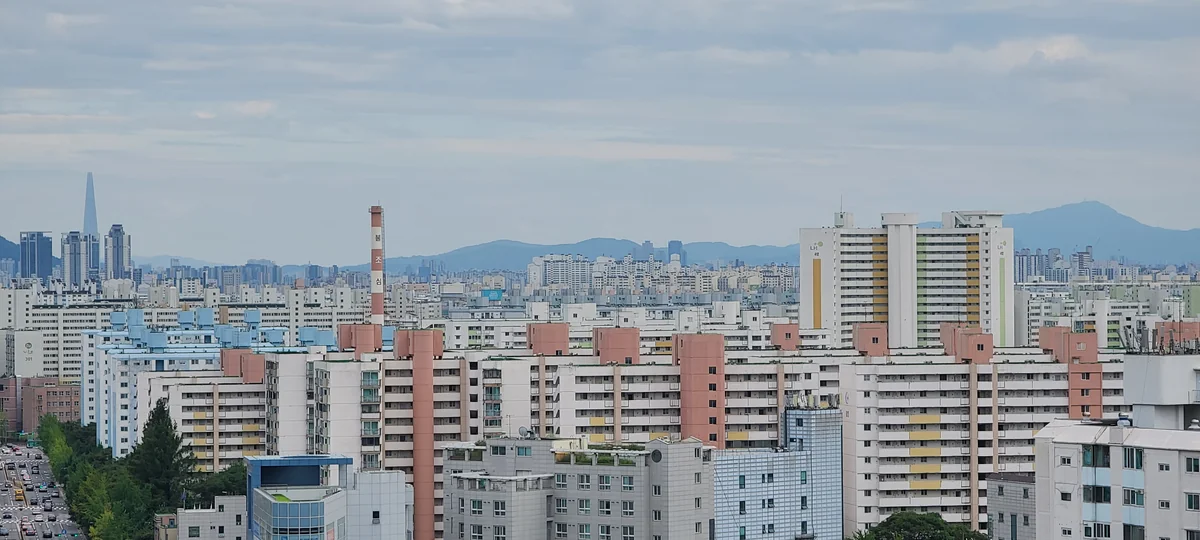 Nowon-gu apartments, Seoul — inter-building gaps, sunlight, complex scale at a glance (CC BY-SA 3.0, Ox1997cow)
| # | Item | Check |
|---|---|---|
| 6 | Entrance + landscaping | Main gate vibe, trees/lawn care. First impression = management level |
| 7 | Parking ⭐ | Spaces per unit (<1.0 = night shortage), weekday 10 PM occupancy |
| 8 | Inter-building distance | Can you see into adjacent living rooms? (~25m+ is healthy) |
| 9 | Sunlight | 10 AM–3 PM lighting check. Prefer south/southeast/southwest exposure |
| 10 | View | What's visible from living room/master bedroom? Buildings/mountains/river/roads |
| 11 | Elevator | Age (20+ years = replacement due), routing, capacity |
| 12 | Management state | Exterior paint, cracks, cleaning, recycling — reflects management fee efficiency |
| 13 | Layout (corridor vs walk-up) | Walk-up = privacy + heating cost / corridor = ventilation, cheaper |
| 14 | Security | CCTV locations, entry system (lobby + unit), guard station |
Always do night viewing for parking. Daytime-empty complexes often face double-parking at 10 PM.
3. Unit Interior (14 items) ⭐ Most Important
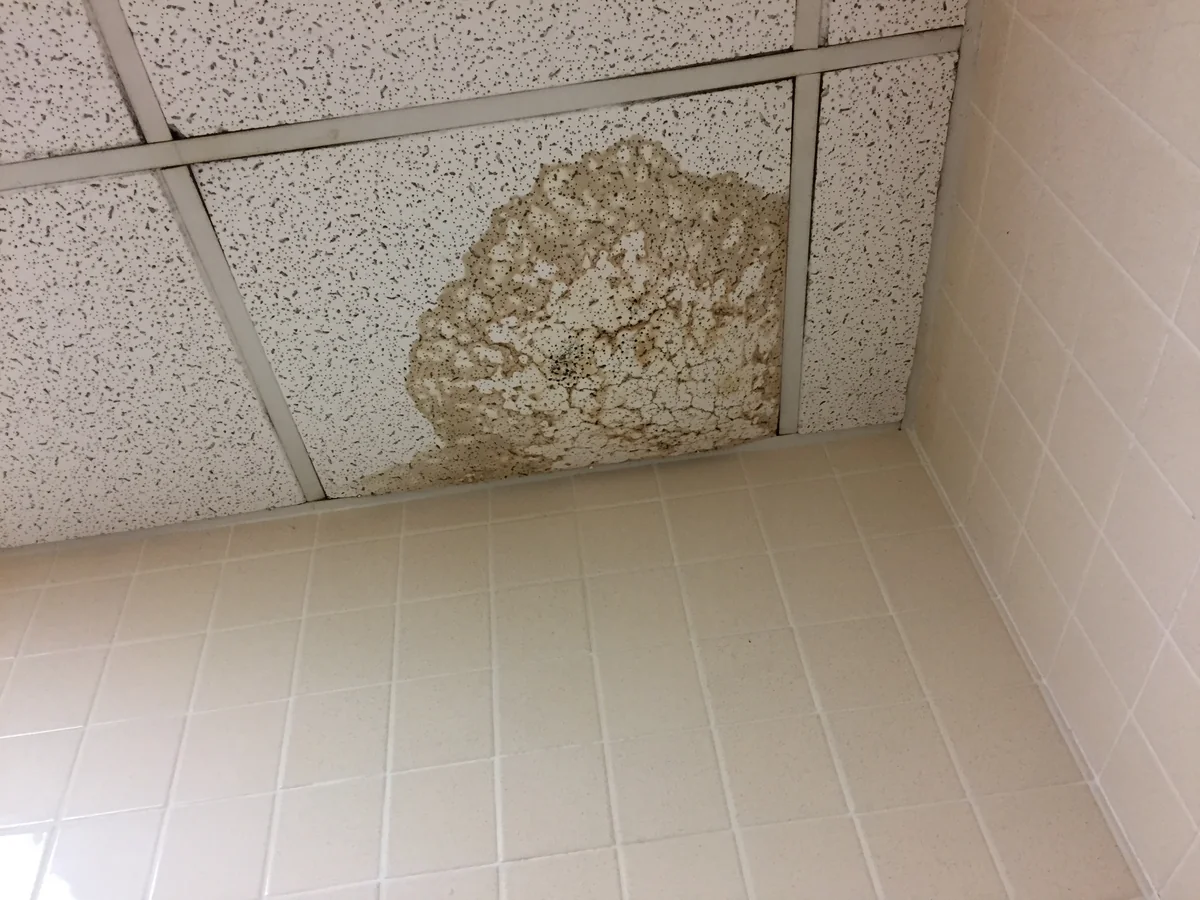 Ceiling water damage — yellow stain means old leak. Fresh paint covers it but it resurfaces in 1-2 years (CC BY 3.0)
The 6 bolded items below are the most expensive to repair.
| # | Item | How to check |
|---|---|---|
| 15 | Layout | Rectangular/L-shape/3-bay. Simulate furniture placement |
| 16 | Ventilation | Living room ↔ balcony ↔ bedroom airflow. Cross-ventilation? |
| 17 | Mold/condensation ⭐ | Bathroom, balcony, wall corners, window frames. Black spots/peeling paint = condensation history |
| 18 | Water leak marks ⭐ | Yellow stains on ceiling/balcony wall. Fresh paint hides it but it returns in 1-2 years |
| 19 | Water pressure | All faucets simultaneously (bath + kitchen + laundry) — weak = deprioritize |
| 20 | Drainage | Sink/bathtub/balcony — how fast water drains |
| 21 | Window frames (sash) ⭐ | Most expensive repair (5–20 million won). Check aging carefully |
| 22 | Wallpaper / flooring | Did previous tenant redo? Suspect new wallpaper hiding mold/leaks |
| 23 | Ceiling moulding ⭐ | Stand on a chair. Unfinished sections = repair marks = leak history |
| 24 | Baseboard bottom ⭐ | Gap between baseboard and floor / cracked silicone = water/humidity damage |
| 25 | Outlets | Layout suitable for appliances? Test all (use phone charger) |
| 26 | Soundproofing ⭐ | Knock on walls adjacent to neighbors. Hearing neighbor's TV = bad sign |
| 27 | Heating (boiler) | Type (gas/district), age (15 years = replacement due), function |
| 28 | Balcony expansion | Matches registry? (Illegal expansion = administrative risk) |
Repair cost reference (2026, 24-pyeong/79㎡):
- Window frame replacement: 5–20 million won
- Boiler replacement: 2–4 million won
- Mold/condensation treatment: 1–5 million won
- Full wallpaper + flooring: 3–6 million won
→ If these are aged, use them as price negotiation leverage.
4. Time-of-Day Visits (3 rounds)
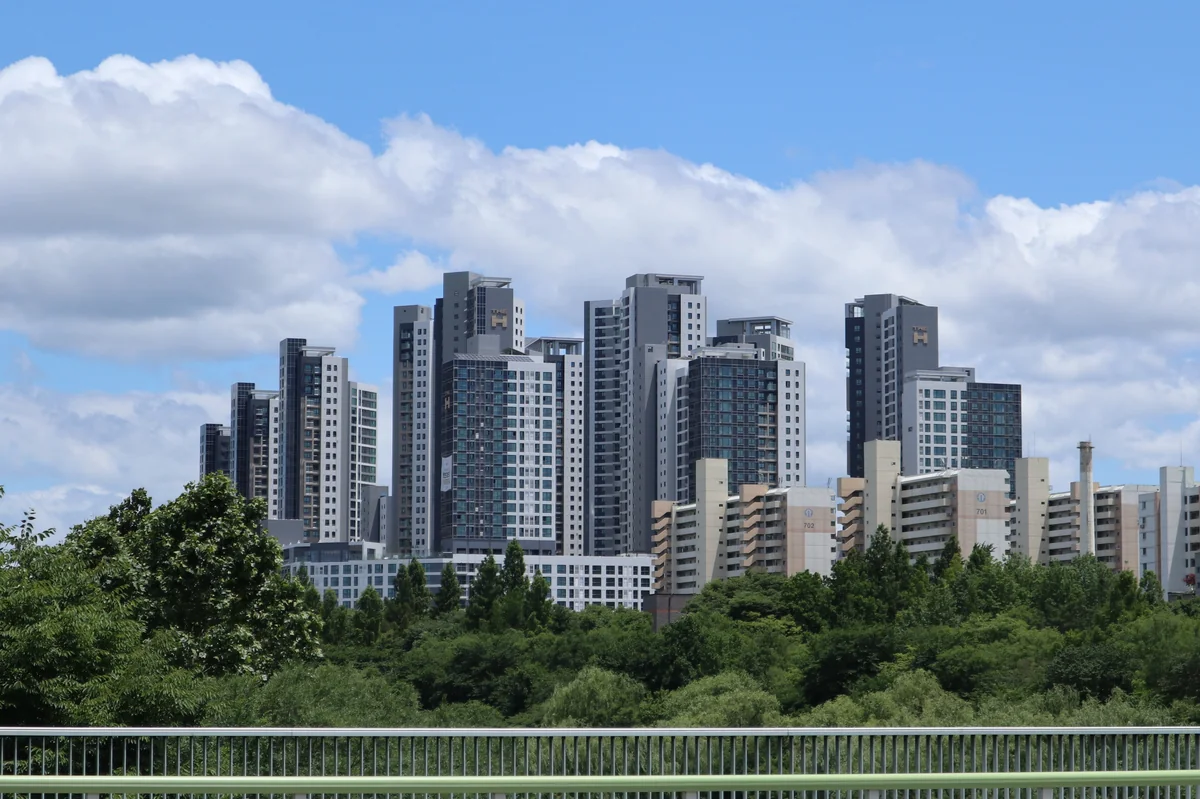 The H Xi Gaepo — even new complexes require evening/weekend verification (CC BY-SA 4.0, S_h_y_numis)
Same property looks different by time:
| Round | Time | What to check |
|---|---|---|
| 1st | Weekday 10 AM–3 PM | Sunlight, traffic, neighborhood vibe, detailed unit inspection |
| 2nd | Weekday 8–10 PM | Parking occupancy ⭐, night noise, street lights, security |
| 3rd | Weekend afternoon | Parking shortage, neighborhood activity, school/park usage |
One weekday daytime viewing only → #1 regret cause. Night parking, noise, security only catch on evening visits.
5. Contract Info (6 items)
| # | Item | Notes |
|---|---|---|
| 32 | Move-in date | Match your schedule |
| 33 | Final payment | Flexibility (loan timing adjustment?) |
| 34 | Occupancy | Vacant vs. occupied (occupied = limited negotiation time) |
| 35 | Agent fee | Negotiable within legal cap |
| 36 | Registry ⭐ | Mortgages, attachments, trust — get it yourself before contract |
| 37 | Recent sales | MOLIT real-price system or Hogangnono — 1-year trend |
Always pull registry yourself (₩1,000 at iros.go.kr). Don't trust agent-provided documents alone. Pull again on contract day for changes.
6. Recording & Organization (5 items)
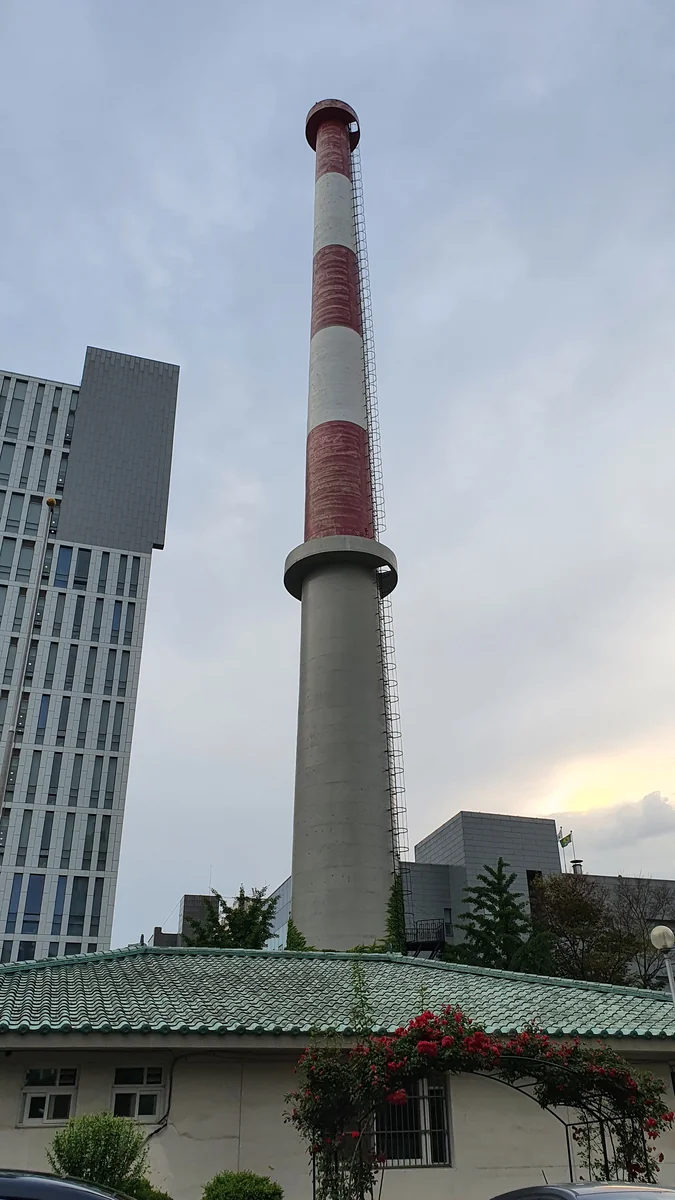 Old apartment — paint, cracks, chimney show management visually (Public domain, Ox1997cow)
After 10–30 viewings, memory alone fails. Use:
| # | Tool | Recommendation |
|---|---|---|
| 38 | Sequential photos | Exterior → living → balcony view → parking → entrance. 5–10 phone shots |
| 39 | Video | 30s walkthrough (living → balcony) catches soundproofing + layout |
| 40 | Voice memo | Naver Clova Note auto-transcribes agent explanations |
| 41 | Location (address + coords) | See box below |
| 42 | Comparison spreadsheet | Listing name, price, area, rating, notes — sort/filter for comparison |
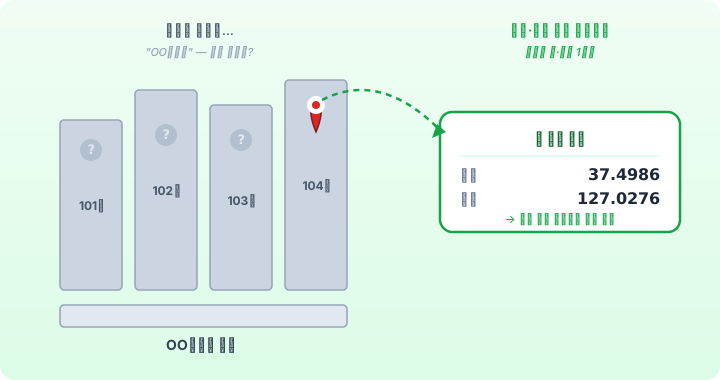
💡 When address alone is ambiguous — also note lat/lng
Even with "OO-dong OO Apartment Building XX Unit YY," it can be hard to pinpoint the exact building within a large complex. If you note lat/lng (e.g., 37.4986, 127.0276) alongside the address in your viewing notebook, any map app can navigate to the exact spot in 1 second.
Convert an address to coordinates here, or long-press the location on any phone map app to display them.
💬 Frequently Asked Questions
Q. How much time per viewing?
A. 20 min interior + 20 min complex/neighborhood ≈ 40 min. 5 viewings = half day. Calm 3–5 visits beat rushed 8.
Q. Can I visit without an agent?
A. Complex and neighborhood — yes. Unit interior — agent required (resident consent). Scout complex first, then book unit viewings.
Q. How many photos per viewing?
A. Exterior 1 + interior 5–7 + balcony view 1 + complex entrance/parking 2 ≈ 10 photos. Minimum to identify it 1 year later.
Q. How soon should I decide after viewing?
A. Good listings sell in 24–48 hours. But always do 2nd evening viewing first. Same-day contracts from first impression are the #1 regret source.
Q. Where do I get the property registry?
A. iros.go.kr — ₩1,000, instant PDF. Compare with agent-provided document.
Q. How to estimate boiler/window frame age?
A. Boiler: production date sticker. Window frames: profile color fading, gasket rubber hardening. For certainty, get a contractor quote.
📝 Summary
- Imjang requires category-based checklists — memory alone leads to regret
- 5 location + 9 complex + 14 interior + 3 time-based + 6 contract + 5 recording = 42 items
- 6 critical interior items: mold, leak marks, window frames, ceiling moulding, baseboard, soundproofing
- 3 visits recommended — weekday day + weekday night + weekend
- Record by: photos, video, voice, location (address + coords), comparison sheet
One well-prepared viewing beats five sloppy ones. Slow, by category, across time-of-day — the foundation of a regret-free purchase.